Cosco-owned Piraeus Europe Asia Rail Logistics (PEARL), Goldair, and the consortiums of Damco and the FDL Group, and Italian-owned Trainose and Sarmed have expressed interest in the concession of the 1.45-square kilometer plot in the Thriasio area by Hellenic Railways Organization (OSE) for the development of a new transit center.

This is the tender for the "Thriasio II" center, which is next to the 0.6 sq.km. "Thriasio I" plot, conceded to the ETBA VIPE - Goldair consortium.

March 31 is the deadline Brussels has set for the concession of the plot and if that is missed Greece will have to return 235 million euros of EU subsidies for the center’s development.

source: http://www.ekathimerini.com/238705/article/ekathimerini/business/four-parties-express-interest-in-creating-a-second-thriasio-transit-center


The Athens Roadmap for Inclusive Growth in Cities was launched on Monday in the Greek capital, which is hosting the fourth meeting of the Organization for Economic Cooperation and Development's (OECD) Champion Mayors for Inclusive Growth Initiative.

During an event held at City Hall, OECD Secretary-General Angel Gurria and Athens Mayor Giorgos Kaminis presented the document which “charters the way forward on how cities can leverage innovation, in particular, public sector-related, technological and social innovation, in order to bolster their inclusive growth agendas,” according to an OECD press release.

More than 30 mayors and municipal representatives from all over the world participated in the meeting, supporting the roadmap, which is the most detailed action plan adopted since the initiative's launch in 2016, Gurria said.

“The roadmap is a guide for cities and their leaders on how to seize innovation as a tool for more inclusive growth... Champion Mayors commit to leverage the full potential of innovation to ensure that we progress together as a society,” he emphasized, addressing the event.

Noting that currently half of the world's population lives in urban centers, Gurria explained that starting from the level of cities the target is to continue to exchange views and agree on policies to tackle together rising inequalities worldwide.

“We must create cities and societies sustainable for all citizens... In this effort, cities should hold a leading role... We seek growth for all, growth that will leave no one behind,” Kaminis said on his part.

On Tuesday and Wednesday the mayors will join ministers at the OECD's regional development ministerial meeting at the Athens Concert Hall to discuss common challenges such as globalization, digitalization, climate change and demographic issues, as well as proposed policies for their management under the theme “Megatrends: Building better futures for regions, cities and rural areas.”

European Commissioner for Regional Policy Corina Cretu represents the EU in the three-day meetings in Athens.

“In a changing world, faced with economic, social and demographic challenges, I remain convinced that Cohesion Policy is one of the best tools the EU has to remain ahead of the curve. It will help us achieve the transition towards a fairer, more sustainable society in Greece and in Europe,” she said, according to an e-mailed press statement from her office. [Xinhua]

source: http://www.ekathimerini.com/238712/article/ekathimerini/business/oecd-launches-athens-roadmap-for-inclusive-growth-in-cities

Greece will invite investors to submit expressions of interest for the commercial operations of its gas utility DEPA on April 8, DEPA’s chief executive officer Dimitrios Tzortzis told reporters on Tuesday.

Earlier this month Greece passed legislation to split Public Gas Corporation (DEPA) into two companies, one covering its wholesale and retail gas supply business and the other its distribution network and international activities.

Under its latest agreement with the country’s creditors, Athens has agreed to sell a 50.1 percent stake in DEPA’s commercial operations.

Speaking on the sidelines of an energy conference in Athens, Tzortzis also told reporters there was interest from Italy, France and Spain.

[Reuters]

source: http://www.ekathimerini.com/238734/article/ekathimerini/business/depas-commercial-operations-go-up-for-sale-in-april

Greek shipowners will pay at least 75 million euros ($85.37 million) annually to the state budget, the prime minister’s office said on Wednesday, under a deal that replaces a previous voluntary arrangement.

The sum is equivalent to a 10 percent levy on dividends, according to a statement by Prime Minister Alexis Tsipras’s office.

Along with tourism, shipping is a pivotal sector for the Mediterranean country. Greek shipowners operate some of the world’s biggest tankers and bulk carriers. Greek shipping accounts for almost half of the EU’s total fleet capacity.

Tsipras said that under Greek law shipowners are not obliged to agree on any contribution and that the deal was a “significant” contribution to the country’s efforts to emerge from a debt crisis that has lasted nearly a decade.

“We must all realise that emerging from the crisis means bigger business opportunities,” Tsipras said.

Greece had for long granted generous tax allowances to its shipowners, a situation which Tsipras had pledged to end when he was first elected in 2015 but had not pursued since then.

Since 2014, Greek shipowners have made voluntary payments to the state under an agreement which expired last year. The new deal makes the payments permanent, the PM’s office said.

Shipowners have repeatedly warned that hiking taxes could push them to relocate abroad.

Theodore Veniamis, president of the Union of Greek Shipowners (UGS) said the industry was supporting “the effort the government is making for a better future in Greece.”

[Reuters]


US oil giant ExxonMobil announced on Thursday the discovery of a significant offshore gas find in Cyprus’s Block 10, Kathimerini Cyprus reported.

According to the preliminary interpretation of the data, the natural gas reservoir at the Glaucus-1 well is estimated between 5 trillion to 8 trillion cubic feet.

The company said it will analyze the data in the coming months to get a clearer picture of the reserve's potential.

The discovery is the largest gas find in the country’s Exclusive Economic Zone (EZZ) so far.

Earlier in the day, ExxonMobil Vice President of Exploration for Europe, Russia, and the Caspian, Tristan Aspray, briefed Cyprus President Nicos Anastasia's on the company’s initial finding.

ExxonMobil and partner Qatar Petroleum started drilling in block 10 of Cyprus’s exclusive economic zone (EEZ) in mid-November. Noble Energy made a significant discovery in the country's Aphrodite field in 2011, while last February, Italy’s ENI discovered Calypso in block 6, though confirmatory drilling is still pending.

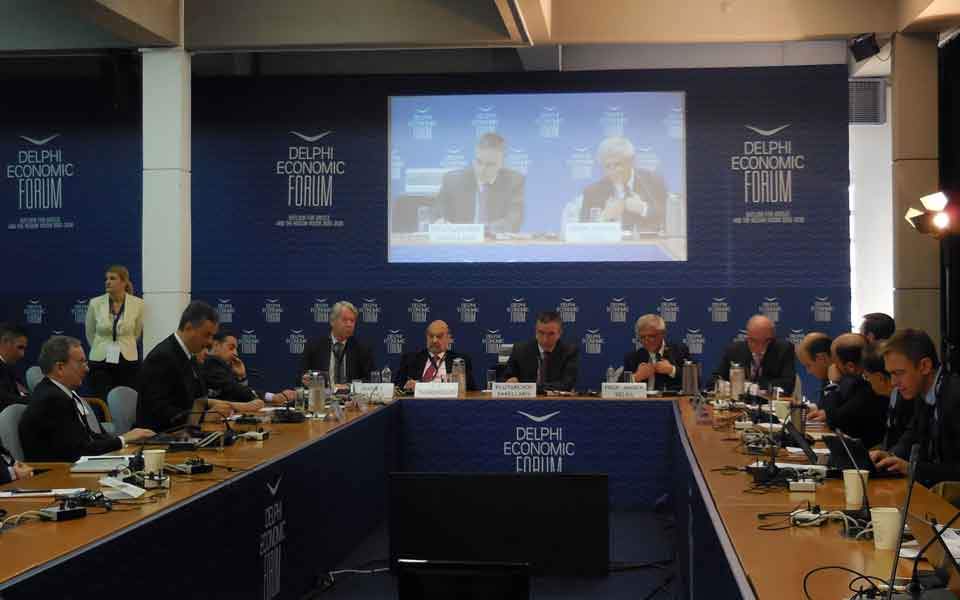
The Fourth Delphi Economic Forum gets under way on Thursday, with an impressive program featuring 95 sessions, as well as representatives from 24 countries, 500 speakers from around the world, 2,500 delegates and over 200 accredited members of the press from Greece and abroad.

The international meeting this year bears the title “The Challenge of Inclusive Growth” and will take place at the European Cultural Center of Delphi, in central Greece, and the nearby Amalia Hotel.

Among the figures set to attend are the president of the Greek Republic, the prime minister, the leader of New Democracy and European commissioners, along with university professors, politicians and entrepreneurs from Greece and many more countries. The heads of Greece’s biggest business groups have also confirmed their participation.

Major emphasis will be placed on the shifts and restructurings brought about by the Fourth Industrial Revolution, new trends in technology, the future of retail commerce, payment technologies, the digital transformation of enterprises and other contemporary issues. The event will also focus on the European Union ahead of the European elections this May.


Travel receipts amounted to 15.847 billion euros in the first 11 months of last year, Bank of Greece data showed on Tuesday, posting an annual increase of 9.7 percent, or 1.41 billion euros.

It is now clear that receipts had exceeded 16 billion by the end of last year – a new record. Incoming tourism traffic came to 29.47 million visitors in the same period, an increase of 10.6 percent from a year earlier.

The November data in particular showed that the seasonal character of Greek tourism is receding, as that month revenues increased 42.4 percent year-on-year.


source:http://www.ekathimerini.com/236895/article/ekathimerini/business/revenues-from-tourism-point-to-2018-being-a-record-year


As next year looks set to bring multiple challenges in global markets, it is important for Greece to convince international investors that the fiscal risk has diminished and to normalize its credit system, UBS Wealth Management Global Chief Economist Paul Donovan tells Kathimerini.

Donovan also notes that the government’s pledge of handouts is not a positive message to investors, though it is not surprising in an environment where political stability has come under increasing pressure.

It has been four months since Greece emerged from its last bailout program, but it still has not managed to tap the markets through a new bond issue. What, in your view, is the reason for this inability to return to the markets?

Greece is showing a primary surplus and this reduces the element of urgency in tapping the markets. Recently, due to the situation with Italy, the bond markets – especially in Europe – are highly volatile, so tapping the market may not make so much sense. We find ourselves in an environment where interest rates are growing internationally, liquidity in the global markets has decreased and the political uncertainty in Italy has reminded international investors of the political risk in Europe.

In the case of Greece, which is looking for international funds, this has played an important role, so the reaction to Greek bonds has been stronger in comparison with other bonds in the eurozone. However, Italy is not alone responsible for the Greek state’s inability to tap the markets, as Greece’s low credit rating is also playing a significant part in attracting investors to Greek bonds.

Greece is in pre-election moder and the Greek government is pursuing a policy of handouts instead of one aimed at attracting investments. How do investors perceive this?

Handout talk is not a phenomenon exclusive to Greece. Pressures around political activity have increased, as we have also seen in the case of French President Emmanuel Macron. This policy is not surprising for investors, particularly in Greece’s case. The markets will certainly not have a positive reaction to such declarations, because they are looking for policies that will attract capital. Still, if they judge that these policies are not upsetting the country’s fiscal prospects, they are likely to tolerate them to an extent, as they acknowledge that a degree of political stability is desirable.

In the long-term, what are your forecasts about Greece’s prospects for 2019?

The eurozone economy is slowing down and in this environment Greece’s growth will remain at a relatively steady rate of 2 percent in the next 12 months. This is because the economy is coming out of a period of deep streamlining, domestic demand has stabilized and export growth is expected to continue. Even so, bank credit remains next to zero and in the absence of a smooth banking system the country is not expected to enjoy normal trends in investments and growth.

One major challenge for Greece is developments in Turkey. In our view Turkey will go into recession in 2019 and this will also affect Greece due to the trade relations between the two countries.

How will changes in European Central Bank policy affect the yields of Greek bonds?

Greece did not participate in QE, so supply and demand for Greek bonds will not really change after it ends. If German yields change due to the rise in ECB rates, this will not necessarily mean that the Greek ones will go up too. That will depend on how the investors weigh the Greek risk. If they see the Greek risk decreasing, then the spread will go down.

Therefore, what will be important for Greece in this new environment is how it presents itself to the international community. Whether it will be able to persuade international investors that the country’s fiscal risk has been reduced and that growth will continue in the medium-term.

Many argue that what Greece needs is an investment shock. How could this take place in today’s environment, ahead of a general election too?

There is a question in international economy over what “investment” means exactly. Why are investments at a low level internationally, in an environment of such low interest rates? Part of the problem is that it is hard to count the investments in an economy with many structural reforms. And the more an economy is orientated toward the service sector, as is the case with Greece, the harder it is to assess the investments. Following the significant reduction of labor costs which has somewhat improved competitiveness, and based on the trend in international trade that could assist Greece, the country does have prospects – if it makes the most of them.

Nevertheless, Greece’s biggest drawback is that a great number of young people have left the country due to the crisis, and this is a worrying trend as far as investments are concerned. If you persuade young people that there is a future in their own country, then they will employ their skills to the benefit of the Greek economy. More business-friendly policies as well as a reduction to tax rates would also help in that direction.

Source: http://www.ekathimerini.com/235742/article/ekathimerini/business/greece-must-prove-it-means-business

Under the Auspices of


Login

Log in to your account or